






Bring six things to the first meeting: a goal written in numbers, your products' profit structure, past advertising data and account access, a definition of your customer, the resources you can commit, and how sales progress in your business. When this information is ready, the work starts on the job itself from the first week; when it is not, the first month goes on emails, waiting for access and guesswork.
Most delays at the start of an engagement come not from the agency but from missing information. A digital marketing agency cannot know on its own what your margin is, which product actually makes you money or what was tried last year. In the agency world, the short document in which this information is gathered is called a brief; the more complete the brief, the more realistic the first proposal and the first plan. The sections below explain, in order, which information you should prepare and why, and what you should ask the other side in the first meeting.
Write Your Goal in Numbers
"We want to increase sales" is not a goal, it is a wish. One person reads that sentence as doubling revenue, another as maintaining current revenue with less spending. These are two very different pieces of work.
Write the goal in three parts:
- How many: how many orders or inquiries do you expect per month? What is that number today?
- At what cost: what is the most you are willing to pay for one order or inquiry?
- By when: three months or a year?
Example: "Today we receive 400 orders a month. We want to reach 700 within six months, and we are willing to pay at most 250 TL in advertising cost per order." These three sentences are more useful than a presentation running to pages, because whether the goal is realistic and which channel to start with can be discussed straight away. Measures like these are called key performance indicators, or KPIs for short; putting in writing at the first meeting which indicator will be the benchmark also determines how later reports will be read.
Also state your priority. Growth and profitability often cannot both be maximised at the same time. If you are willing to accept lower profit for a while to gain market share or, on the contrary, want every order to be profitable, saying so from the start changes how campaigns are set up.
Map Out Your Profit Structure and Prices
Only you can know whether advertising is profitable, because only you know your costs. Ad dashboards show revenue; they do not show how much of that revenue you keep. Gather the following information on a single page:
- Cost and selling price by product or product group.
- Shipping, packaging and payment commission.
- Return rate and the cost of returns to you.
- Average order value.
- The products that earn you the most and the least.
This list directly affects two decisions: which products will be put forward and which products will not be advertised at all. Using advertising to grow a product that sells well but leaves almost no profit increases revenue while reducing profit. We explained with an example how to calculate how much you can pay for an order in our article on setting a budget.
We often come across businesses that are reluctant to share figures. If you do not want to give exact amounts, give ratios: in which product group is your profit margin high, in which is it low, and roughly what percentage of an order do you keep? Even this much allows campaigns to be managed by earnings rather than by revenue.
Prepare Past Data and Account Access
If you have advertised before, the data from that period is the most valuable starting material. Which audience, which keyword and which visual worked or did not work is written there. Starting from scratch means buying that knowledge again with money.
Which accounts are needed?
- Advertising accounts: Google Ads, Meta and the other platforms you use.
- Measurement tools: Google Analytics, Search Console and the tag manager.
- The merchant account where your product list is kept (for shopping ads).
- The e-commerce panel or the system where customer records are kept.
- Social media pages.
- Contact details of the person or company that can make changes to the site.
How should you grant access?
You should be the owner of all accounts. The accounts should be opened with your company's email address, and the agency should be added to them as a user or partner. Do not share passwords. This setup protects two things: your historical data stays with you when the engagement ends, and you can remove access with a single click.
If your accounts were opened in the name of a previous agency or a former employee, ask for them to be transferred before the new engagement begins. An account that cannot be transferred can mean losing years of accumulated data.
The way access is granted differs slightly for each account. The table below shows the general route and the point to watch for commonly used accounts; the current details of the steps are on the platforms' help pages.
| Account | How is access granted? | Point to watch |
|---|---|---|
| Google Ads | Add the agency's email as a user or link the account to the agency's manager account | Keep the account and billing information in your company's name |
| Meta ad account and pages | Add the agency as a partner from your business account on Meta | Your business should own the ad account and the page |
| Google Analytics and Search Console | Add the agency's email as a user | Grant administrator or owner rights only if necessary |
| Tag manager | Add the agency's email as a user | Agree from the start on who will publish changes |
| Merchant account where your product list is kept | Add the agency's email as a user | Share which system feeds the list |
| E-commerce panel | Create a separate user for the agency | Grant permission only to the sections needed; do not share passwords |
What has been tried before?
Share old reports if you have them. If not, a short note is enough: in which period, on which channel, roughly how much was spent and what was the result? The sentence "We tried Meta, it didn't work" says nothing on its own; if it is known what was shown, to whom and for how long, the same mistake is not repeated.
Know the State of Your Site and Measurement
Advertising brings visitors to your site; the site makes the sale. That is why, before starting work, you need to set out the state of your site honestly. Here is what you need to prepare:
- What platform does your site run on, and who can make changes to it?
- How many days does it take to change a page's text or image?
- Are steps such as purchases, form submissions and phone calls being counted right now?
- Are there known problems on the site: slow-loading pages, sections that look broken on mobile, orders abandoned at the payment step?
If measurement is not set up, do not hide it; it is set up as the first task. In a campaign that starts without measurement, it cannot be known which ad brought in sales, and the spending of the first weeks ends without teaching anything. If making changes to the site takes weeks, say that from the start too; the plan is then built to begin with steps that do not require a landing page.
Define Your Customer
You know best who buys from you. This information is the foundation of everything from ad copy to the target audience. Write short answers to these questions:
- Who buys your product? Whatever you know, such as age, city or occupation.
- Why do they buy from you? Price, quality, speed or trust?
- What is the most common reason people give up on buying?
- What questions does customer service receive most often?
- In which periods of the year do sales rise, and in which do they fall?
- Who are your three to five main competitors, and what sets you apart from them?
Customer reviews, frequently asked questions and the objections your sales team hears are a ready source for this section. Most good ad copy comes from the customer's own words.
Clarify the Resources You Can Commit
Advertising spend and service fee
The amount paid to the platforms and the service fee paid to the agency are separate items; set each one separately. Stating clearly how much you can allocate in total each month saves you from wasting time on a plan that does not suit you.
Images and video
Gather the product photos, videos, logo and brand colour information you have in one folder. Can you do new shoots, and if so, how often? In social media advertising, content determines results more than anything else, and content has to be refreshed regularly.
Communication and approval
Who on your side will follow the work, and who will give approvals? If a campaign needs three people's approval to go live and this takes a week, knowing it from the start makes the schedule realistic. Appointing a single authorised person speeds up the work noticeably.
Stock and delivery
When advertising works, will you be able to meet the increased orders? Advertising a product that is out of stock, or orders delivered late, turn the money spent into negative reviews. Share in advance which products may run into stock problems.
How Do Sales Progress in Your Business?
If the sale is not completed on the site, that is, if the visitor fills in a form or calls, the success of the advertising depends on what happens after the inquiry. Prepare the following:
- Who responds to incoming inquiries, and how quickly?
- Where are inquiries recorded?
- Out of ten inquiries, how many turn into a meeting, and how many into a sale?
- On average, how long does it take to close a sale?
Without this information, campaigns are managed only by the number of inquiries, and the system tries to bring in the cheapest inquiries. The cheap inquiry and the customer who buys are often not the same person.
Agree on How You Will Work from the Start
If it is unclear who will do what and when, even the best plan falters. Clarify these points in the first meeting:
- Meeting frequency: a short weekly call, or a detailed monthly review?
- Day-to-day communication: through which channel will questions be asked, and how quickly will they be answered?
- Decision authority: which changes can the agency make without asking, and which require approval?
- Emergencies: who will be notified when the site goes down, stock runs out or a campaign is cancelled?
There is also information you need to share regularly: upcoming discounts, price changes, new products and stock levels. A team that learns about these on the last day has to launch the campaign unprepared.
What Should You Expect in the First Three Months?
Setting expectations correctly is the least discussed but most important part of preparation. Advertising work does not run at full efficiency from day one.
The first month mostly goes on setup: verifying measurement, organising the accounts, launching the first campaigns and collecting the first data. During this period spending is kept low and the figures fluctuate. In the second month, audiences, keywords and visuals that do not work are eliminated, and spending shifts to what does. From the third month on, if cost is below the target, spending is scaled up gradually.
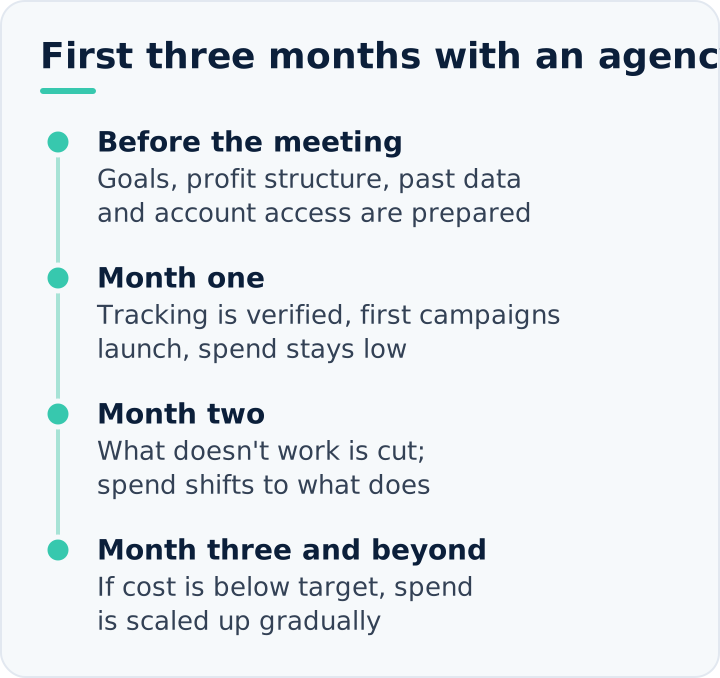
This timeline is not the same for every business. A business with historical data, measurement in place and content ready moves faster. Even so, judging the work by the results of the first two weeks means judging a system that is still in its learning period.
Questions You Should Ask the Agency
Preparation is not one-sided. Ask these questions to get to know the team in front of you:
- Who will handle our account day to day, and will we be able to talk to that person directly?
- How often will we receive reports, and with which figures?
- If the engagement ends, who will keep the accounts and the data?
- How long is the contract, and what are the exit terms?
- How is the service fee calculated: fixed, or proportional to spending?
- What will be done in the first thirty, sixty and ninety days?
- What will you need from us, and when?
- Can you show an example of work you did with a similar business?
For the last question, you can look at our case studies; there we state clearly in which period, with which method and with what result the work was done. If you are meeting more than one agency, ask all of them the same questions; putting the answers side by side makes choosing an agency easier.
Warning signs to watch for
- A guarantee of a specific ranking or sales figure. Most of the factors that determine results are not fully under anyone's control.
- Not being given access to the ad account, or the account being opened in the agency's name.
- Reports that consist only of impressions and clicks, with no sales or costs.
- No questions at all about your margin, your stock levels or your customer.
The more questions you are asked, the harder the digital marketing agency you will work with is trying to understand your business. A team that sends a proposal without asking any questions may be applying the same plan to everyone.
The List to Bring to the First Meeting
- A goal written in numbers: volume, cost limit and timeframe.
- A table of cost, price and profit by product.
- Monthly order and revenue figures for the last twelve months.
- A list of advertising and measurement accounts; who owns each one?
- A short summary of what has been tried before.
- Customer definition, frequently asked questions and main competitors.
- The amount you can allocate for monthly advertising spend and the service fee.
- A folder of images and videos.
- The authorised person on your side and the approval process.
- The questions you will ask the other side.
If the whole list is not ready, do not postpone the meeting; completing the gaps together is also part of the work. In the first meeting we go through these headings and decide together what to do about the missing ones. You can take a look at how we work as a performance marketing agency or request an initial meeting by writing to us through our contact page.
Frequently Asked Questions About Starting Work with a Digital Marketing Agency
How are digital marketing agency fees set?
Agency fees are usually structured in one of three ways: a fixed monthly fee, a fee proportional to advertising spend, or a mix of the two. Some agencies charge a separate setup fee at the start; image and video production can also be a separate item. When getting a proposal, ask in writing what the fee includes, and in the spend-based model, factor in that the fee will rise as spending rises.
What happens to ad accounts and data when you change agencies?
If the accounts were opened in your name, nothing is lost: you remove the old agency's access, add the new one, and the historical data stays in place. If the account was opened in the agency's name or within the agency's business account, a transfer may not always be possible. To guard against this risk, export the campaign structure and past reports before the engagement ends; also check which account the measurement tags on your site are linked to.
How long should a contract with an agency be?
Make the initial term long enough to cover at least the setup, elimination and scaling steps of the first three months, but do not commit to a term that makes leaving difficult. Because the first months of advertising work go on setup and learning, a trial of a few weeks rarely allows a sound decision. On the other hand, a contract that ties you in for a long time with unclear exit terms is also a risk; have the notice period, and how accounts and reports will be handed over when the engagement ends, written into the contract.
What is the difference between a performance marketing agency and a digital marketing agency?
A performance marketing agency runs its work by measurable results, meaning sales, inquiries and their cost; a digital marketing agency is a broader umbrella that also covers work such as social media management, content and design. If your goal is direct sales or inquiries, check whether the reports of the team you are meeting include these results and their costs.
Is it safe to give an agency my sales and profit figures?
Yes, if a mutual confidentiality agreement has been signed; these figures are needed for a sound plan anyway. If you are hesitant, ask for the agreement before the first detailed meeting; until then, you can share ratios instead of exact amounts. Keeping the tables in a folder in your own company account and only giving the agency access to it also ensures that control stays with you when the engagement ends.