






A discount increases the number of orders, but it cuts your earnings per order by far more than the discount rate. If your profit margin is 40 percent, a 20 percent discount halves the amount you earn on each sale; to keep the same earnings, you need to sell twice as much. Once advertising spend is added, a week of record revenue can leave you with less money than an ordinary week.
This does not mean you should never offer discounts. A properly structured campaign to clear stock, win new customers or grow basket value is profitable. The difference lies in whether the math was done before the campaign. Below, we explain that calculation, the costs that get overlooked, the methods you can use instead of giving everyone the same rate, and the figures you should review once the campaign is over.
A Discount Hits Your Earnings Harder Than Its Rate Suggests
A discount comes off the price, but your costs stay the same. That is why the entire discount comes out of your profit. The amount left after deducting costs that rise with each sale, such as product cost, shipping and payment fees, is also called the contribution margin; it is this figure, not revenue, that determines whether a discount campaign is profitable.
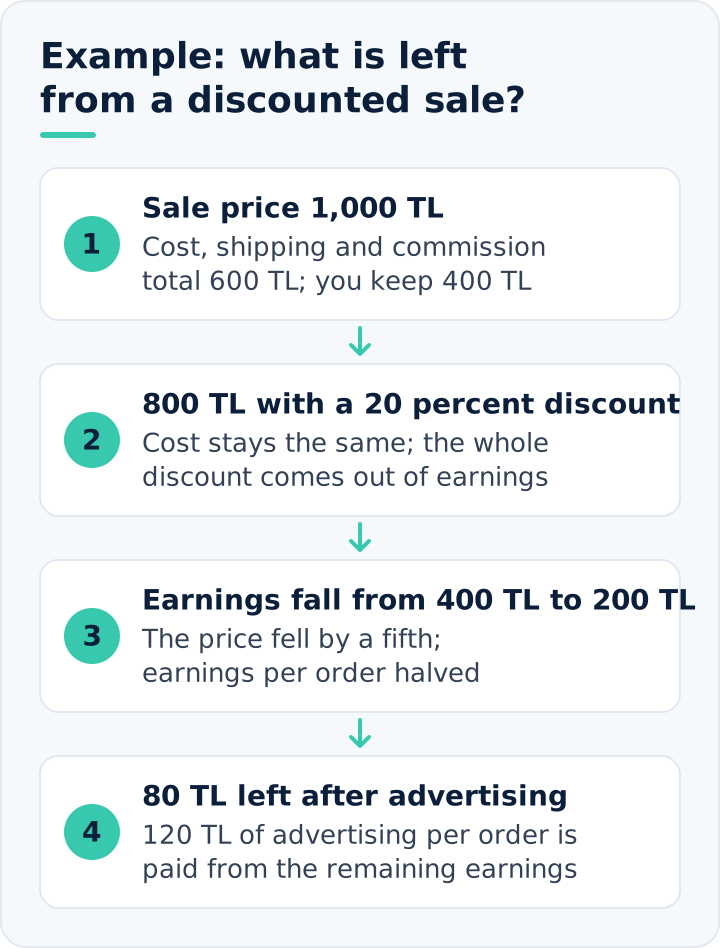
Example: you sell a product for 1,000 TL. The product cost, shipping and payment fee total 600 TL, leaving you 400 TL. With a 20 percent discount, the price drops to 800 TL, the cost stays at 600 TL and your earnings fall to 200 TL. You cut the price by a fifth, and your earnings were halved.
How much more you need to sell to reach the same total earnings comes down to a simple ratio: divide the pre-discount earnings by the post-discount earnings. In the example above, 400 divided by 200 means you need twice the sales. For the same product, the picture changes as follows at different rates:
- At a 10 percent discount, earnings fall to 300 TL; you need roughly one third more sales for the same total.
- At a 20 percent discount, earnings fall to 200 TL; sales need to double.
- At a 30 percent discount, earnings fall to 100 TL; sales need to quadruple.
For low-margin products, the effect is even harsher. On a product with a 25 percent profit margin, a 20 percent discount wipes out four fifths of the earnings and requires five times the sales for the same total. That is why applying the same rate to every product can mean selling low-margin products at a loss.
The table below shows how many times sales must increase to keep the same total earnings at three different profit margins. The calculation is an example that assumes costs such as product cost, shipping and fees are not affected by the discount; you can run the same break-even calculation using the profit margins of your own product groups.
| Discount rate | 25 percent profit margin | 40 percent profit margin | 60 percent profit margin |
|---|---|---|---|
| 10 percent | About 1.7 times the sales | About 1.3 times the sales | 1.2 times the sales |
| 20 percent | 5 times the sales | 2 times the sales | 1.5 times the sales |
| 30 percent | Every sale at a loss | 4 times the sales | 2 times the sales |
How Does the Picture Change Once Advertising Costs Are Added?
There was no advertising in the calculation above. Yet most businesses also increase spending to promote a campaign. The advertising cost per order is paid out of earnings that have already shrunk.
Example: for the same product, you spend an average of 200 TL in advertising per order in a normal period. Deducting 200 TL from 400 TL in earnings leaves 200 TL net per order. With 100 orders a month, you earn 20,000 TL.
In the campaign, you offered a 20 percent discount. Because the discounted price persuaded more people to buy, the advertising cost per order fell from 200 TL to 120 TL. That is a good development, but your earnings had also fallen to 200 TL; you are left with 80 TL per order. If the campaign brought in 180 orders, total earnings come to 14,400 TL.
Put the figures side by side: revenue rose from 100,000 TL to 144,000 TL and the number of orders nearly doubled, but the money left in your hands fell by roughly a quarter. This is why there is less money in the till while everything on the dashboard looks green. This situation, where revenue grows and profit shrinks, is called margin erosion. For the same earnings, this campaign would have needed to bring in 250 orders.
In peak periods, one more factor comes into play: because everyone advertises in the same week, impressions and clicks become more expensive. If the advertising cost per order rises instead of falling, the entire discounted sale can turn into a loss.
The Hidden Costs of a Campaign
Sales pulled forward
Some of the orders that arrive during the campaign are orders that would have come in at full price within a few weeks anyway. Customers either bring their purchase forward or hold off because they have heard about the discount. This is why sales drop in the weeks before and after a campaign. A report that looks only at the campaign days does not show this loss.
Discounts given to customers who would have bought anyway
Your regular customers are ready to buy your product at full price. A public discount is given to these customers needlessly as well. Looking at how many campaign orders came from existing customers shows how much of the discount was wasted.
Returns and operational load
A discount increases the number of orders placed without much thought, and these orders are returned more often. Every return is an extra cost in shipping and labor. On busy days, packing falls behind and questions to customer service increase; an order delivered late turns into a negative review.
Price perception
Frequent discounts teach customers to wait. In a store that runs a campaign every month, full-price sales decline over time, because customers know the next discount is near. The discounted price becomes the product's real price in their minds.
When Does a Discount Make Sense?
- To clear stock. Out-of-season products or products sitting in the warehouse tie up space and money every month. With these products, the goal is not earnings but recovering the tied-up money; selling at a low profit is the right decision here.
- To win new customers for repeat-purchase products. If your customers regularly reorder, earning less on the first order is made up for by later orders. Verify this with your own repeat purchase data, not with assumptions.
- To grow basket value. A discount given above a certain amount gets customers to add one more product to their basket.
- On high-margin products. On a product with a 60 percent profit margin, a 20 percent discount takes away one third of the earnings; if sales rise by half, the numbers work.
- On dates when the whole market is running campaigns. In periods such as late November, not being visible at all can mean leaving customers to your competitors. We covered how to prepare for these dates in our Black Friday article.
Methods You Can Use Instead of the Same Rate for Everyone
A single rate across all products is the easiest method, but also the most expensive. There are ways to achieve the same sales effect with less loss of earnings. In the targeted promotions below, the benefit is tied to a specific basket, product or customer group.
- Spending threshold: an offer such as "150 TL off orders of 1,500 TL or more" pulls the average basket up and gives the discount only to large baskets.
- Product bundle: selling products that are used together at a bundle price offers a benefit without lowering individual product prices, and clears slow-selling products alongside fast-selling ones.
- Free shipping threshold: customers often add one more product to their basket to avoid paying for shipping.
- Free gift: a gift with a low cost but high perceived value can work out cheaper than lowering the price.
- First-order discount for new customers only: you win new customers without giving your regular customers an unnecessary discount.
- Discount on a specific product group only: you select high-margin or overstocked products and keep the rest at full price.
- Early access: giving existing customers the right to enter the campaign a day early, instead of a deeper discount, rewards loyalty without spending money.
Example: say your average basket is 1,200 TL. The "150 TL off orders of 1,500 TL or more" offer goes to customers who add one more product to their basket. For a customer whose basket rises to 1,600 TL, this discount stays below 10 percent, while you make 400 TL more in sales. Had you given the same customer 20 percent off all products, you would have given a larger discount and not grown the basket.
What these methods have in common is that they give the discount not to everyone, but to the people whose behavior you want to change.
Coupon Code or a Public Discount on the Website?
A discount visible to everyone on the website has the broadest impact, but it is the most expensive, because everyone buys at the discounted price, whatever brought them to the site that day. A coupon code, on the other hand, gives the discount only to those who know the code. You can send the code to newsletter subscribers, people who abandoned their cart or the followers of a specific partnership, while keeping the list price unchanged on the site. When you give each channel its own discount code, you can also measure how many orders each channel brought in.
The weakness of coupons is leakage. A generic code quickly ends up on coupon sites and is used by people searching for codes at checkout who had already decided to buy. To prevent this, generate personal or single-use codes and set an expiry date.
Who Should You Announce the Campaign To, and Through Which Channel?
Advertising is not the cheapest way to reach your existing customers. If you have an email and messaging list, announce the campaign through these channels first; the cost is far below that of advertising. Reserve advertising spend for people who do not know you yet and those who visited your site without buying. Reaching the same person through both messaging and advertising means paying twice for the same sale.
State the discount clearly in the ad copy: the rate or amount, the scope and the end date. The offer in the ad and the offer on the page that opens after the click must be exactly the same. Writing "Up to 50 percent off" and sending visitors to a page where most products are 10 percent off wins the click but loses the sale.
The Calculation to Do Before the Campaign
Before deciding on a discount rate, write down the answers to three questions.
What is the campaign's single main goal? Earnings, clearing stock or new customers? If the goal is unclear, so is how you will measure success. Judging a stock clearance campaign by earnings, or a new customer campaign by that week's profit, leads to the wrong conclusion.
What is the maximum discount you can offer in each product group? Rank your product groups by profit margin. For each group, calculate the earnings left after the discount and the sales increase needed for the same total earnings. If the required increase is unrealistic, lower the rate for that group or leave the group out of the campaign.
How much can you spend on advertising per order at the discounted price? Your normal-period limit does not apply during a campaign, because your earnings have shrunk. For the example product, while you could spend 200 TL in a normal period, during a 20 percent discount campaign the same amount wipes out all the earnings. You can find how this limit is calculated in our advertising budget guide.
Finally, check your stock. Advertising money spent on a product that sells out on the second day of the campaign is wasted, and the customer leaves disappointed.
Which Figures Should You Review After the Campaign Ends?
Revenue during the campaign days is not the measure of success. To see the real result, look at these five figures:
- Total earnings after advertising. Compare the amount left after deducting costs and advertising spend, not revenue, with a normal period.
- The weeks before and after. Also take into account the two weeks before and the two weeks after the campaign. If sales dropped in these weeks, the campaign merely pulled part of your sales forward.
- Share of new customers. How many of the orders came from first-time buyers? If this share is low, you gave the discount to people who would have bought from you anyway.
- Return rate. Compare the return rate of campaign orders with a normal period and deduct the cost of returns from your earnings.
- Whether new customers come back. Do customers who came in through the discount reorder at full price within two to three months? If not, what you gained was not a customer but a one-off sale.
Recording these figures after every campaign lets you set the rate and scope of your next discount campaign based on your own data, not guesswork.
A Short Pre-Campaign Checklist
- Write down the campaign's single main goal.
- Rank your product groups by profit margin; leave out low-margin ones or lower their rate.
- For each group, calculate the sales increase needed to reach the same earnings.
- Check whether you can use a spending threshold, a product bundle or a new customer discount instead of a single rate.
- Reset your advertising limit per order based on the discounted price.
- Prepare your stock, shipping capacity and customer service for the campaign volume.
- Decide in advance which five figures you will review after the campaign and which period you will compare them with.
During campaign periods, managing advertising spend by earnings produces very different results from managing it by revenue. In our performance marketing work, we start the campaign plan from the profit margins of product groups and set the limits for Meta and search advertising accordingly.
Frequently Asked Questions About Discount Campaigns and Profit Margins
How do you set a profitable discount rate?
Work backwards from the sales increase you expect. Example: on a 1,000 TL product you keep 400 TL, and you estimate the campaign will increase sales 1.5 times. To keep total earnings the same, at least 400 divided by 1.5, or about 267 TL, must remain per sale after the discount. That means a discount of at most 133 TL, or about 13 percent. If advertising spend will also rise, the limit goes even lower.
Is free shipping or a discount more profitable?
If your shipping cost is lower than the discount amount you would give, free shipping is more profitable; moreover, the cost of a percentage discount rises as the basket grows, while the shipping cost usually stays the same. Example: on a 1,200 TL basket, a 10 percent discount costs you 120 TL; if your shipping cost is 80 TL, free shipping on the same basket costs you 40 TL less in lost earnings. Do the calculation by product group; for heavy or bulky products, shipping can cost more than the discount.
Should a discount be shown as a percentage or in TL?
Choose whichever looks bigger to the customer; the cost to you is the same either way. On low-priced products the percentage, and on high-priced products the TL amount, is usually the bigger number: on an 80 TL product "25 percent" looks bigger than "20 TL", while on an 8,000 TL product "800 TL" looks bigger than "10 percent". In basket-threshold offers, a TL amount also fixes the upper limit of the discount.
Is it right to raise the price before a campaign and then show a discount?
No; this practice misleads customers and damages trust in the brand. Comparison sites and browser extensions that show price history easily expose a price increase made just before a campaign. Misleading discount displays may also breach consumer protection law; before the campaign, check how you should show the pre-discount price against current regulations.
How long should a discount campaign last?
The campaign's goal determines its length; but a short period with a start and end announced in advance makes it easier to plan stock and shipping and to measure the results. Plan a stock clearance campaign around the amount of stock you want to clear, and a new customer campaign around your cost-per-customer limit. Do not extend the end date you announced: a campaign billed as the "last day" and then extended undermines the credibility of your next announcement.