






In most cases, no. Increasing spend while results are getting worse means buying more of the same poor result at a higher price. Increasing only works when the cause of the drop is insufficient spend: the campaign is profitable but its daily amount runs out early, or the money is split into so many pieces that the system cannot learn. In every other case, you first need to find the cause.
When sales drop, it is understandable that the first reaction is to raise spend; it looks like the fastest way to win back lost orders. But ad performance does not drop for a single reason, and each reason has a different fix. Below, we explain how to tell whether the drop is real, the questions to ask to find its source, the situations in which increasing or cutting is the right call, and the approach to follow when raising spend.
First, Confirm That the Drop Is Real
Not every drop you see in the dashboard is real. Check three things before you make a decision.
Are you comparing the right periods?
When comparing this week with last week, make sure the days of the week match. Payday week and the end of the month, or a holiday week and a normal week, are not the same. Look at the same period last year too; if sales drop in these weeks every year, what you are seeing is not a problem but seasonality.
Has the data for the last few days settled?
Someone who clicks an ad today often does not buy straight away; the order comes a few days later and is recorded in the report against the day of the click. That is why the figures for the last three or four days often look worse than they really are. Comparing yesterday with the same day last week and panicking is the most common mistake.
Is measurement working?
An update to the site, a change on the checkout page or a setting in the cookie consent banner can silently stop sales from reaching the ad dashboard. Compare the number of orders in the dashboard with your own order records. If real orders have stayed the same while the number in the dashboard has dropped, the problem is not in the ads but in measurement. In that case, both increasing and cutting spend would be wrong; measurement is fixed first. You can confirm that conversion tracking works with a small test order; tag-checking tools that run as browser extensions will show you within a few minutes whether the purchase tag fires on the order confirmation page.
Five Questions to Find the Source of the Drop
Have clicks become more expensive, or has the purchase rate fallen?
Cost per order is made up of two things: the price of a click and how many of the people who click go on to buy. In the ad dashboard, these two parts appear as cost per click and conversion rate; cost per order is the first divided by the second. Example: if a click costs 5 TL and two out of every hundred visitors buy, an order costs 250 TL. If the click rises to 7 TL, the cost becomes 350 TL; the problem lies in competition or in the ad itself. If the click stays at 5 TL but only one in a hundred visitors starts buying, the cost becomes 500 TL; the problem lies in the site, the price or the offer. The fixes for these two situations are completely different.
Is the drop everywhere, or in one place?
Look at it by campaign, device and product group. If every campaign drops at the same time, the cause is shared: the site, pricing, the season or measurement. If only one campaign drops, the cause lies inside that campaign: a worn-out visual, a shrinking audience, a change in a competitor's offer. If the drop is only on mobile, something has broken on the mobile site.
What changed on your side?
Look at the two weeks before the day the drop began and write down everything that changed: a price increase, a promotion that ended, a change in shipping fees, a best-selling product going out of stock, a redesign on the site, a change to payment methods. The answer is usually somewhere on this list. For cases where clicks come in but sales do not, we set out the order of checks in a separate article.
What changed in the ad account?
Check the account's change history. A bid target may have been changed, a well-performing ad paused, an ad rejected in review, or a newly launched campaign may have started competing with an older one for the same audience. If more than one person works in the account, changes like these are often made without anyone noticing. If the day the drop began matches the day a change was made, you have found your answer; the fix is not to increase spend but to undo the change.
What changed outside?
A competitor may have launched a big discount. Impressions and clicks may have become more expensive at a time when the whole market is advertising. Demand for your product may have fallen for seasonal reasons. You cannot change these factors, but knowing about them stops you from making the wrong decision: increasing spend while demand has fallen is searching for customers who are not there.
Was the Drop Sudden or Gradual?
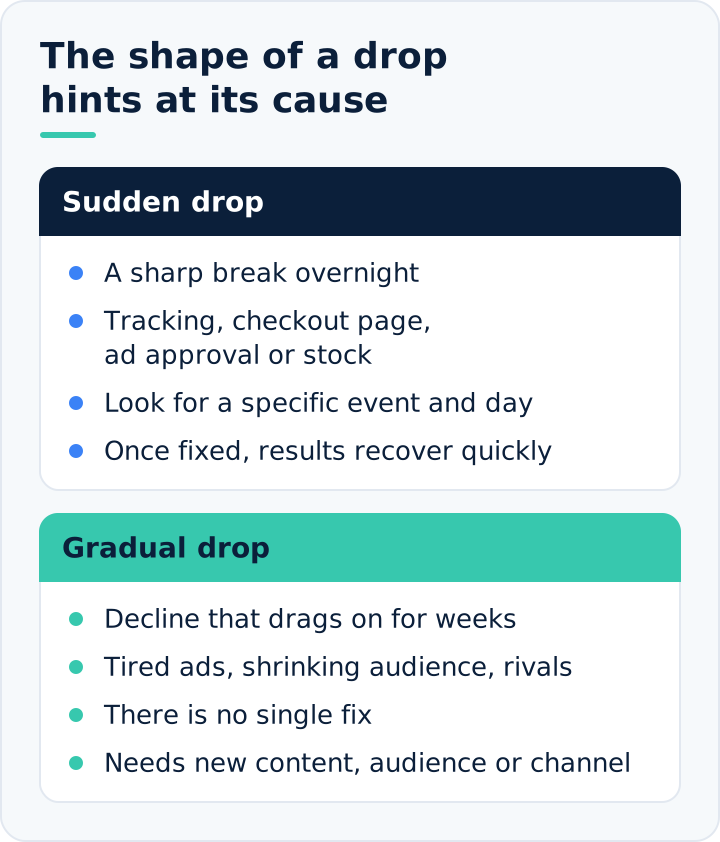
The shape of the drop gives a strong clue about its cause. Look at your daily orders chart.
If there is a sharp drop from one day to the next, something has broken: the tracking code, the checkout page, an ad's approval or stock. In drops like these, what you are looking for is a specific event, and once it is found, results recover just as quickly.
A picture that worsens gradually over weeks, on the other hand, points to wear: visuals shown to the same people again and again, a shrinking audience, rising competition or a channel that has reached saturation. There is no single fix here; you need new content, a new audience or a new channel. In neither case is the answer more money, but the work to be done is different.
Why Doesn't Increasing Spend Solve the Problem?
Ad systems reach the people who are easiest to persuade first. When you increase spend, the system expands towards people who are harder to persuade and less interested. That is why, even in normal times, every extra lira you add returns less than the one before. Known in economics as diminishing returns, this effect is the natural limit of budget scaling. When results have already worsened, the effect becomes even heavier.
Example: in a normal period, you spend 20,000 TL a month and get 100 orders; that is 200 TL per order. The most you can pay for an order is 250 TL, so you are in profit. Then a drop happens and the same 20,000 TL now brings in 70 orders; that is 286 TL per order. To win back the lost orders, you raise spend to 30,000 TL and get 95 orders. The number of orders has come close to where it was, but cost per order has risen to 316 TL. You are now losing far more on every order than before the drop, and doing so at a larger volume.
With small audiences, there is another problem. As spend rises, the same people see your ad more often. Beyond a certain point, this repetition does not increase interest; it creates fatigue, and the click-through rate falls. In search ads, extra spend starts showing your ads for searches that are less relevant to your product.
Another cost of large, sudden changes is the system's stability. A campaign whose daily amount is doubled overnight often goes back into a learning process and delivers results that are even worse than before for several days.
When Increasing Is the Right Call
- The campaign is profitable but its daily amount runs out early. If cost per order is below your limit and the campaign stops in the afternoon, you are missing out on evening sales.
- You are losing impression share in search ads because of spend. If people are searching for your product but your ad is not showing because the amount is not enough, extra spend goes straight to the relevant person.
- The money is split into too many pieces. If each campaign gets only a few sales a week, none of them can learn. The fix here is often not to increase the total but to merge campaigns; if that is still not enough, increasing makes sense.
- Demand is rising with the season. If search volume is rising and you are in profit, not raising spend in line with demand hands the sales to your competitors.
- A new test is delivering clearly good results. If a visual or audience you tested with a small amount is bringing in orders comfortably below your limit, it is right to shift money here from weaker campaigns and, if needed, grow the total.
- What has dropped is volume, not efficiency. If cost per order is where it should be but total orders have fallen, your ad performance has not actually deteriorated; only your share has shrunk.
What these situations have in common is this: in all of them, cost per order is below the limit. That is the precondition for a decision to increase. To see whether the budget is genuinely not enough in search campaigns, check the impression share lost due to budget in Google Ads; if the share lost due to rank is high, the problem is not money but the quality of the ad or the bid amount.
When Cutting or Waiting Is the Right Call
- If measurement is broken. Do not grow spend while you cannot see what is working. Hold the current level, or cut it slightly, until measurement is fixed.
- If there is a problem with the site or stock. If the checkout step is throwing errors or a best-selling product has sold out, pause the related campaigns until the problem is solved. We calculated the effect of losses at the checkout step on cost in our article on cart abandonment.
- If cost has been above the limit for weeks. Waiting on a campaign that has not improved for two or three weeks is expensive. Rather than switching everything off, switch off the least efficient audience, keyword or product.
- If demand has fallen. Reducing spend in line with demand in the off-season is saving the money for the busy period.
Switching everything off at once, however, is rarely the right decision. When campaigns stop, what the system has learned goes stale; when you restart, the first weeks are inefficient. Keep the campaign that captures people searching for your brand, and the best-performing core, running.
The decision to increase or cut usually follows from the situation you see in the numbers. The table below matches common situations when ad performance drops with their likely causes and the budget decision:
| What you see | Possible cause | Budget decision |
|---|---|---|
| Orders in the dashboard dropped, real orders unchanged | Measurement has broken | Leave it; fix measurement first |
| Clicks got more expensive, purchase rate unchanged | Competition, seasonality or a worn-out ad | Do not increase; review the ad, the keywords and the bid strategy |
| Click price unchanged, purchase rate dropped | Site, price, stock or promotional offer | Do not increase; fix the problem on the site or in the offer |
| Cost below the limit, budget runs out before the day ends | Budget not enough | Increase in small steps |
| Demand fell with the season | Overall market interest has fallen | Cut in line with demand; save the money for the busy period |
| Cost above the limit for weeks | Inefficient audience, keyword or product | Switch off the weakest part; protect the core |
How to Increase Spend Safely
Move in small steps
Rather than multiplying the amount in one go, make small increases and wait a few days after each one. That way, the system's stability is not disrupted and you can see at what level efficiency starts to fall.
Look at the cost of the added orders, not the average
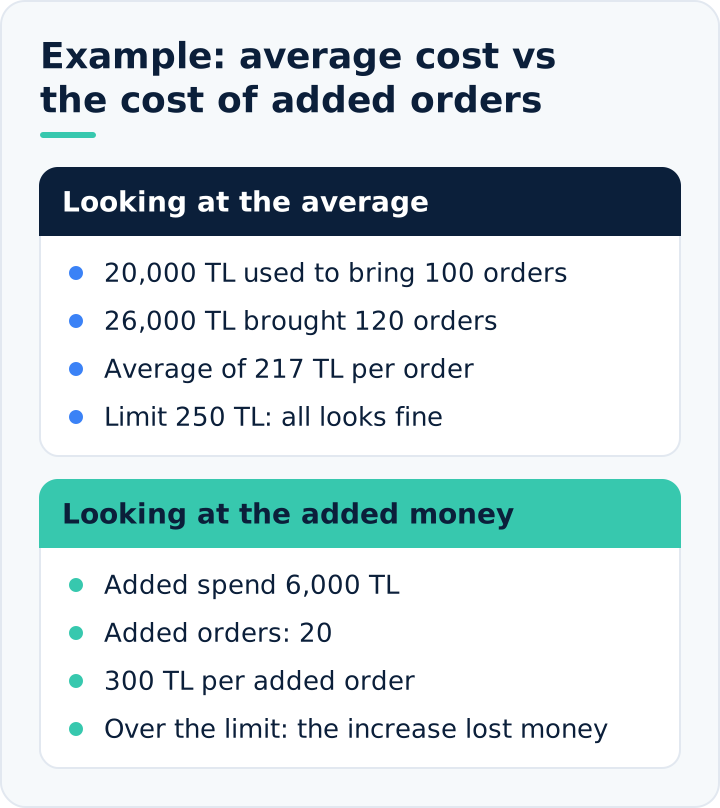
Example: you were getting 100 orders with 20,000 TL. You raised spend to 26,000 TL and got 120 orders. The average cost is 217 TL; it is below your limit of 250 TL and everything looks fine. Yet the 6,000 TL you added brought in only 20 orders; each of those orders cost 300 TL. The last increase lost money, but the average hid it. The right question is not "what is the average?" but "what did the orders brought in by the money I added cost?" This figure is also called the marginal cost per order.
Write your stopping rule in advance
Before increasing, decide which figure will make you go back. A rule such as "If the cost of added orders stays above 250 TL for two weeks, I go back to the previous level" takes emotion out of the decision.
Grow your material along with the money
You cannot keep growing spend forever with the same visual, the same audience and the same product; at some point, saturation is reached. Adding new visuals, new audiences, new keywords or new products gives the extra spend somewhere to go.
Other Levers to Check Before Money
Most drops are fixed without touching spend at all. Check these in order:
- Visuals and videos. If the same ads have been running for weeks, the click-through rate may have fallen. New content is often the step that delivers results fastest.
- Landing page. Does the product or offer the ad promises appear on the first screen of the page that opens after the click?
- Offer. Your price, shipping terms or promotion may have fallen behind your competitors'.
- Search terms. In search campaigns, check which searches your ad appears for and exclude the irrelevant ones. In our Google Ads management work, this clean-up is done every week.
- Product list. In shopping ads, are the product name, image and price up to date? Are out-of-stock products still being shown?
- Audience exclusions. Are campaigns looking for new customers being shown to your existing customers?
The Order to Follow for the Decision
- Confirm the drop: periods of the same length, settled data, working measurement.
- Split the cost in two: has the click price risen, or has the purchase rate fallen?
- Find where it is: all campaigns, a single campaign, or a single device?
- List what has changed on your side and in the market over the last two weeks.
- Fix the cause you found and wait a week or two.
- If the campaign is profitable and limited by spend, increase in small steps; watch the cost of the added orders.
- Note what you did and the result; this note will be the first place you look at the next drop.
Cases where earnings fall even though the ratio looks good are a separate topic; we covered that in our article on ROAS and losses. If you cannot find the cause of the drop on your own, as a performance marketing agency we can look at your account and site together with you and work out whether the problem is in the ads, the site or measurement.
Frequently Asked Questions About Ad Performance and Budget Decisions
How much should an advertising budget be increased at a time?
There is no rate that applies to everyone; the measure is that the cost of the added orders stays below your limit. Example: instead of taking a campaign that spends 1,000 TL a day to 2,000 TL overnight, if you raise it to 1,200 TL and then 1,400 TL a few days apart, you disrupt the system's stability less and you also see at what level efficiency starts to deteriorate.
What is the learning phase, and how does a budget change affect it?
The learning phase is the period in which, for a newly launched campaign or one that has had a major change, the ad system rediscovers whom to show the ad to and when. Results fluctuate during this time; Meta shows this in the ad set's delivery status, and Google Ads in the bid strategy's status. Large changes made one after another to the budget, the goal or the audience extend this period.
Does lowering the budget hurt ad performance?
A measured reduction usually does not; because the most expensive orders drop off first, cost per order may even improve. The problem is cutting the amount so low that the campaign cannot get regular results; at that point, the system cannot gather enough data and results fluctuate. If you need to cut, rather than trimming every campaign a little, switch off the least efficient campaign and keep the amounts of the rest unchanged.
Does duplicating and relaunching a campaign whose performance has dropped work?
It rarely works. The duplicate campaign starts learning from scratch and may compete with the old campaign for the same audience; any improvement seen in the first days may be nothing more than fluctuation during the learning period. If the cause of the drop is a worn-out visual, a problem on the site or broken measurement, the duplicate carries the same problem. Launch a new campaign only if the goal, the audience or the structure is genuinely going to change.
How can I tell whether demand or the ads have dropped?
You can tell by looking at the market's overall interest. Look together at the trend in searches related to your product on Google Trends, the number of impressions in your search campaigns and your site's organic traffic. If all three are falling at the same time, demand has decreased; if searches are holding steady and only your ad results have worsened, the problem lies in the account, the site or the competition. Auction insights in Google Ads also show changes in your competitors' visibility.