






Most brands that achieve strong results in November campaigns begin by preparing tracking, their website and their ad account weeks ahead, rather than choosing a discount rate. There is little to do on campaign day beyond increasing budgets, monitoring stock and responding to problems. Almost all decisions that shape the outcome are made during the preceding six weeks.
This year, Black Friday falls on Friday, 27 November; many brands extend their sale to the start of that week or even the first days of November. The plan below works backwards over six weeks and assigns one main task to each week. Sequence matters, because ads prepared with broken measurement will also be managed using incorrect data. If you intend to start your November sale earlier, shift this schedule back accordingly.
Why Start Preparing Six Weeks Ahead?
There are three reasons. First, advertising platforms cannot immediately absorb a new campaign or a major budget change; learning which ads to show to which people takes time. A setup built from scratch during campaign week goes through its learning phase on the most expensive days.
Second, tracking errors only emerge through testing. If you discover on campaign day that purchases are counted twice or not at all, that day’s data cannot be recovered. Third, everyone advertises in November: impression costs rise and the same budget reaches fewer people. Building customer lists and remarketing audiences in advance is the one source that remains inexpensive in this costly period.
A brief note: good Black Friday preparation need not be perfect. A brand that completes four of six tasks on time performs better than one that leaves everything until the last week.
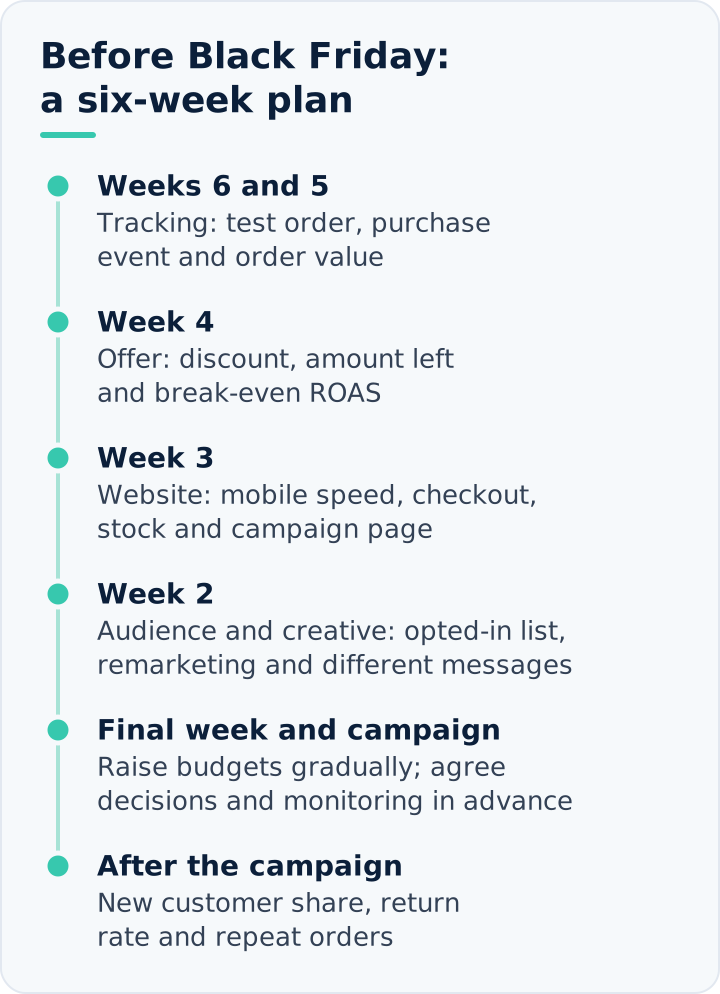
The diagram below shows the six-week schedule; we explain each week in detail in the sections that follow.
Weeks Six and Five: Strengthen Measurement
The first two weeks should confirm that sales are counted correctly. The ad dashboard, analytics tool and ecommerce order records should show similar numbers for the same day. Exact equality is not expected, but a large discrepancy must have an understood cause.
What to check
- Does the purchase event fire once per order? Place a test order and confirm it appears as a single record in the dashboards.
- Is order value transmitted correctly? Know whether it includes shipping and tax, and use the same definition everywhere.
- Are add-to-cart and begin-checkout events working? These show where the funnel loses people during the campaign.
- How are visitors without cookie consent counted? Low consent rates understate sales in dashboards; measure this before the campaign.
- Are bank-transfer and cash-on-delivery orders included in tracking? These payment methods can account for a large share in Türkiye and are often omitted.
If measurement terms are unfamiliar, our digital marketing glossary explains concepts such as conversion, ROAS and acquisition cost with their formulas.
Week Four: Set Your Offer and Profitability Limit
Discounts are often chosen by watching competitors. A stronger approach is to calculate your own limit first: what remains per order after discount, and how much can go to advertising?
For example, suppose your average order value is 1,000 TL and product and shipping costs total 550 TL. A full-price sale leaves 450 TL in gross profit. A 20 percent discount reduces the order value to 800 TL while costs remain unchanged, leaving 250 TL. If you spend all of that 250 TL on advertising, you earn nothing per order; the highest advertising cost per order you can sustain in that campaign is therefore 250 TL. Expressed as ROAS, 800 TL in revenue divided by 250 TL in spend gives a break-even point of 3.2. A brand seeing 3 in its dashboard would be losing money in this scenario.
Recalculate whenever the discount changes. At 30% off in the same example,150 TL remains and break-even ROAS rises to 4.7. Deeper discounts make selling easier, but also increase the advertising efficiency required.
Example: for the same store, changing the discount rate changes the allowable ad cost per order and break-even ROAS as shown below. The calculation assumes an average order value of 1,000 TL and combined product and shipping costs of 550 TL; substitute your own figures.
| Discount rate | Order value | Maximum advertising cost per order | Break-even ROAS |
|---|---|---|---|
| No discount | 1,000 TL | 450 TL | 2.2 |
| 10 percent | 900 TL | 350 TL | 2.6 |
| 20 percent | 800 TL | 250 TL | 3.2 |
| 30 percent | 700 TL | 150 TL | 4.7 |
| 40 percent | 600 TL | 50 TL | 12 |
The final row shows why deep discounts often do not work alongside advertising: at a 40% discount, only 50 TL per order remains for ads, making new customer acquisition very difficult. It is more sensible to reserve such discounts for channels without advertising costs, such as your consent-based customer list.
Alternatives to discounts
There are offers that put less pressure on margin: free shipping above a threshold, a discount on a second item, a gift or discounts limited to selected products. Whichever you choose, its rule should fit in one sentence. Complex conditions do not fit an ad and leave questions on the website.
Week Three: Prepare Your Website for Speed and Traffic
If ad visitors get lost on the site, the budget is wasted. Most campaign traffic comes from phones, so check on your own phone over mobile data, rather than on desktop.
- Do the homepage, category and product pages load within a few seconds on mobile? Remove oversized images and unnecessary plugins this week.
- Complete checkout from start to finish once. Fix mandatory registration, unnecessary form fields or broken payment options now.
- Is inventory current? Advertising an out-of-stock product loses money and customers. Plan extra stock or alternatives for bestsellers.
- Are shipping times and return terms clear on the product page? If peak demand will delay delivery, explaining it upfront is easier than apologising later.
- Create a dedicated campaign page. Ads lead to it, discounted products stay in one place, and the page is easy to close when the campaign ends.
Ask your platform provider whether traffic growth requires precautions. This is usually straightforward with hosted e-commerce platforms; discuss server capacity in advance for custom software.
Week Two: Grow Audiences and Prepare Ad Creatives
The lowest-cost sale during campaign week comes from someone who already knows you. Before the final weeks, focus on growing two lists: customers who consented to communications and recent website visitors. In advertising, these groups are called warm audiences.
For the first, a sign-up field saying “Be the first to hear about the campaign” is enough. Every person who has opted into email, SMS or WhatsApp is someone you can reach on campaign day without advertising spend. For the second, you can run low-budget awareness ads in the preceding weeks; the aim is not sales, but building an audience to remarket to on campaign day.
Preparing visuals and copy
Do not launch a campaign with just one creative. Prepare at least three or four ways of presenting the same offer: a product-focused image, a short video showing it in use, and a simple design highlighting the offer. You cannot know in advance which will work; the platform will favour the stronger option within a few days. Since ad approvals can take longer during busy periods, a safer approach is to upload creatives a few days before the campaign and schedule a later start date.
The two platforms play different roles. Search ads reach people looking for your product or brand; in Google advertising management review branded searches and Shopping campaigns before the promotion starts. Social media ads, by contrast, show the offer to people who are not searching for it. In Meta advertising management, catalogue campaigns and remarketing audiences are among the most effective structures during this period.
Dividing the Budget Across Periods and Channels
Instead of treating the campaign budget as a single amount, divide it into three periods: pre-campaign audience building, campaign days and post-campaign reminders. The pre-campaign share is small but often the most neglected; it builds the audience you will remarket to on campaign day. The largest share goes to the campaign itself. A small amount reserved for afterwards funds final-day reminders to people who added items to their cart but did not buy.
Use your own data to allocate channels. Give more weight during campaign days to the channel that generated orders at lower cost in previous months. Trying a new channel for the first time during campaign week is an expensive experiment. If you want to test one, launch it with a small budget five or four weeks beforehand and enter campaign week with results in hand.
Final Week and Campaign Days: Budget and Monitoring
Suddenly multiplying the budget on campaign morning forces the system to relearn. Increase it gradually during the final week instead, and keep part of campaign-day funding in reserve. Moving budget to a proven winner is more efficient than dividing it equally from the start.
List campaign-day checks in advance and review them two or three times a day, not continuously. Constant monitoring encourages decisions based on one-hour fluctuations. If discounts run through the weekend and Cyber Monday, continue these checks on those days too.
- Is advertising cost per order below the limit you calculated in week four?
- Has the add-to-cart rate fallen below normal? If so, the problem is the page or stock, not the advertising.
- Are there checkout errors? A payment option failing on campaign day can cause major losses within hours.
- Are ads still running for out-of-stock products?
Decide in advance who is responsible for decisions. Should the budget increase at midnight? Which product takes over if stock runs out? Searching for answers on campaign day wastes time. This is why working with a team that manages advertising, the website and measurement together makes things easier; as a performance marketing agency, we manage these three areas together in one plan during campaign periods.
What to Review After the Campaign
The campaign's true outcome becomes clear after returns are finalized. It is easy to celebrate revenue in the first week; the real picture emerges a few weeks later. Look for answers to these three questions.
First, what share of orders came from new customers? If you only offered discounts to existing customers, you may have brought forward sales that would have happened anyway while reducing their margin. Second, does the return rate differ from normal periods? Discounted purchases are returned more readily. Third, do customers acquired during the campaign order again in the following months? The answer determines how much you can afford to acquire a customer in the same campaign next year.
Write these notes as soon as the campaign ends. The most valuable resource for next year’s Black Friday preparations is a short summary of which decisions worked this year.
Common Preparation Mistakes
- Announcing the discount only on campaign day, with no advance communication. A campaign without a prepared contact list depends entirely on expensive advertising.
- Applying the same discount to every product. Low-margin products can become loss-making after ad costs; group products by margin.
- Leaving different offers in the ad and on the page. If visitors cannot find the advertised discount on the page, they leave instead of searching.
- Leaving ads running after the campaign ends. An ad using the same creative after the discount expires wastes money and misleads customers; set the end date in the dashboard from the start.
- Looking only at revenue. If revenue rises while contribution per order falls, losses grow with the campaign.
A Short Weekly Checklist
- Weeks six and five: place a test order and verify that the purchase event and order value appear correctly in the dashboards.
- Week four: choose the offer, then calculate the remaining margin after the discount and your break-even ROAS.
- Week three: test the entire site on your phone, fix speed, payment, stock and shipping information, and prepare the campaign page.
- Week two: grow your opted-in contact list and remarketing audiences; prepare and upload different creative approaches for your ads.
- Final week: increase the budget gradually and document who will make each decision on campaign day.
- After the campaign: review new-customer share, return rate and repeat orders, and record what you learned.
If you cannot fit in all six weeks, keep the order: tracking first, then profitability limits, then the website. Creative and budget can come last; miscounted sales cannot be fixed retrospectively.
FAQs About Preparing for Black Friday
Why does the Black Friday date change each year?
Black Friday’s date changes each year because it falls the day after Thanksgiving, celebrated in the United States on the fourth Thursday of November. It therefore falls on a Friday between 23 and 29 November. In 2026, Thanksgiving is on 26 November, Black Friday on 27 November and the following Cyber Monday on 30 November. You can use this rule to plan next year’s calendar in advance.
Should every brand offer Black Friday discounts?
No. If the margin left after the discount does not cover higher advertising costs, choosing not to participate is also an option. In that case, reduce ad spend during the campaign week, because competing with an undiscounted offer on the most expensive days for impressions is difficult. Focus that week on your consented customer list and people searching for you by name, and save the main budget for your own peak period.
How do you prepare for Black Friday shipping demand?
Discuss daily pickup capacity, additional collection slots and possible peak-period delivery delays with your carrier in advance. Give an approximate forecast of the order increase so extra vehicles or collections can be arranged. Stock up on boxes, protective filling and labels before the campaign too; sometimes it is an empty box supply, not shipping, that holds orders up.
Which products should be advertised on Black Friday?
Advertise products that remain profitable after the discount and have enough stock for the campaign. Rather than making a bestselling but low-margin product the face of the ad, keep it on the campaign page alongside more profitable items. Keep inventory data in product feeds current for catalog and Shopping ads; products marked out of stock will not appear in those ads.
When should you send customers Black Friday announcements?
The simplest and least intrusive schedule is one announcement to opted-in customers on the first day of the sale and another on the final day. A short reminder a day or two beforehand may increase orders in the opening hours, but too many messages in the same week can lead customers to withdraw consent. Before sending, check that the offer in the message matches the website offer exactly.