






The soundest way to set your spending is to work backwards: how much remains from a sale, how much can you pay to generate it, and how many sales do you want each month? With those three numbers, the monthly budget follows naturally. Starting with “What do competitors spend?” or “How much money do I have?” usually leads to spending too little or more than necessary.
The method below applies equally to a new business and one that has advertised for years but sets spending by habit. We will first work out the economics of a single sale, then establish lower and upper advertising budget limits and plan the first three months. The figures in the examples only illustrate the calculation; substitute your own numbers.
First, Calculate What You Can Pay for a Sale
No budget figure is meaningful until you know what an order contributes. Four inputs are needed: average basket value, product cost, shipping and packaging, and payment fees.
For example, suppose your average order value is 1,200 TL. Product costs are 600 TL, shipping and packaging cost 80 TL, and payment processing costs 40 TL, leaving 480 TL. If you spend it all on advertising, the sale earns you nothing; if you keep it all, you cannot advertise. How to split it is your decision. Suppose you want to retain 200 TL of the 480 TL as profit: you can then pay no more than 280 TL to acquire an order.
Complete the fields below to calculate using your own figures. The second column uses the example above; the third shows where to find each number.
| Item | Example amount | Where to find it |
|---|---|---|
| Average order value | 1,200 TL | Revenue for the period divided by the number of orders |
| Product cost | 600 TL | Purchase or production records |
| Shipping and packaging | 80 TL | Shipping contract and packaging invoices |
| Payment processing fee | 40 TL | The fee rate agreed with your payment provider |
| Amount left from the order | 480 TL | Subtract the three costs from the order value |
| Profit to retain | 200 TL | The business's decision |
| Affordable advertising cost per order | 280 TL | Subtract retained profit from the remaining amount |
This 280 TL is the allowable advertising cost per order and the anchor for the entire calculation. If the cost per order in your ad platform is below this figure, you are making money; if it is above, you are losing money on each sale. In advertising, this measure is called cost per acquisition, or CPA; when entered as a bidding target in Google Ads, it is called target CPA. You can express the same limit as ROAS: a 1,200 TL basket divided by 280 TL is about 4.3. In this example, a campaign showing ROAS below 4.3 spends some of the profit you wanted to protect on advertising.
The calculation changes with repeat purchases
If customers regularly reorder, you can tolerate a higher cost on the first order because later orders bring profit. Base this on your own history, not assumptions: how many customers order again, and how soon? Without that data, the first order must pay for itself.
Working Backwards from Your Goal
Once you know your maximum cost per order, the monthly budget is simple multiplication. If you target 150 advertising-driven orders a month and can pay at most 280 TL each, your ceiling is 42,000 TL. Exceeding it eats into profit even if you hit the sales target.
Now calculate the same target from the other direction. How many of every hundred website visitors place an order? At a 1.5 percent rate, 150 orders require about 10,000 visitors. If an average click in your industry costs 4 TL, 10,000 clicks cost 40,000 TL. If the two calculations are close, your target is realistic.
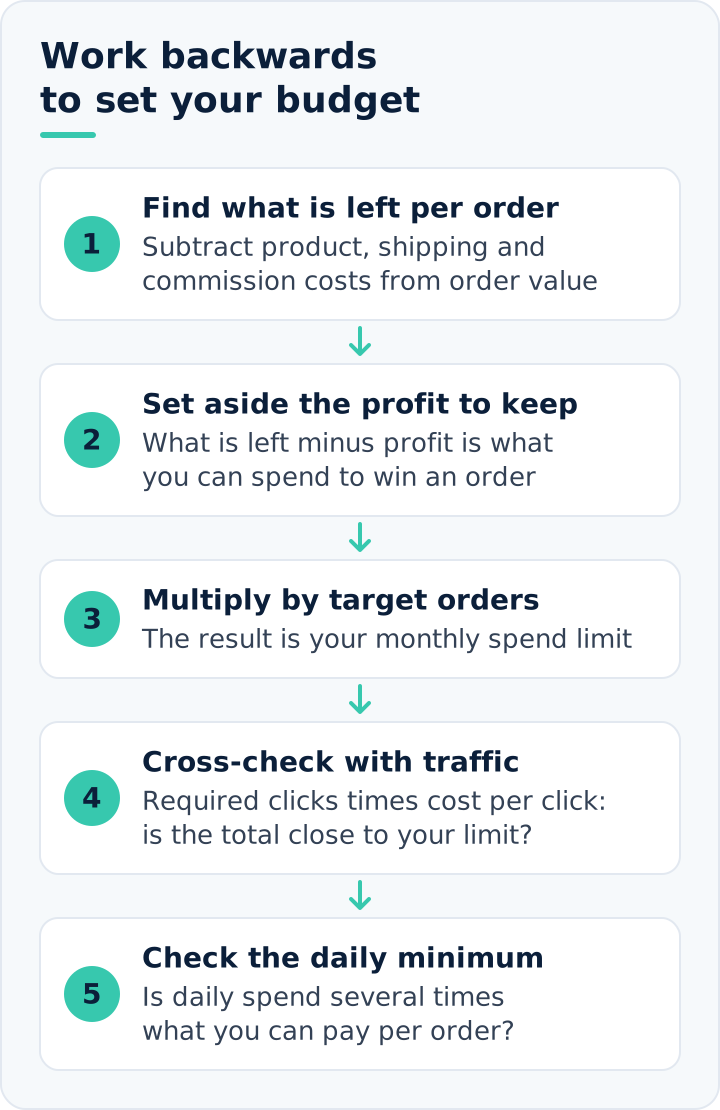
If it does not, one of three things must change. At a cost per click of 8 TL, the same traffic would cost 80,000 TL and cost per order would rise to 530 TL, almost twice the 280 TL limit. You must then reduce the target, improve the site's purchase rate, or increase average order value. Spending more does not fix the equation. The diagram below walks through the calculation.
What Changes When the Sale Doesn't End on the Website?
In sectors such as clinics, consulting, software, or wholesale, visitors do not pay on the website; they submit a form or call. The unit of calculation is an inquiry rather than an order, with one extra step: what proportion of inquiries become customers?
Example: you earn an average of 20,000 TL from a customer and can allocate 4,000 TL to acquiring them. If one in ten inquiries becomes a customer, you can pay at most 400 TL per inquiry. That is the figure to monitor in your advertising dashboard. If inquiry quality is lower and only one in thirty converts, the limit drops to around 130 TL, so apparently cheap inquiries are actually expensive.
That is why sales-team records are part of the calculation for service businesses. Planning without knowing which inquiries become customers may increase lead volume without increasing revenue.
When Does the Percentage-of-Revenue Method Work?
The most common rule is to allocate a percentage of revenue to advertising. It is simple and helps established businesses control spending, but has two weaknesses.
First, the percentage depends on your profit margin. A brand with a 60 percent gross margin may spend 15 percent of revenue on ads, while one with a 20 percent margin would lose money at that rate. Borrowing another business’s percentage is misleading. Second, a new business has no revenue; a percentage of zero is zero. A new brand must initially spend according to the minimum needed to learn, not its revenue.
Use the revenue percentage as a ceiling, not a decision criterion. The real criterion is the cost per order calculated in the previous section.
Comparing common methods side by side makes it clearer which question each answers. For most businesses, the right approach is to work backward from the objective as the main criterion and use other methods as boundaries.
| Method | How is it calculated? | When does it work? | Weakness |
|---|---|---|---|
| Percentage of revenue | Allocate a set percentage of monthly revenue | To cap spending in an established business | Ignores profit margins; new businesses have no revenue. |
| Competitor spending | Use estimated competitor spending as a benchmark | To get a rough sense of market scale | You don't know the competitor's margin or goals |
| Available cash | Set the available amount in advance | To stay within cash limits | Unrelated to the target; it may be too low or too high |
| Work backwards from the goal | Affordable cost per order multiplied by target orders | As the main benchmark for most businesses | Requires knowing margins and purchase rates |
| Minimum learning budget | Daily spend is set at several times the allowable cost per order. | To find the minimum for a new campaign | Does not establish an upper limit on its own |
The Minimum Budget Needed for Learning
Advertising platforms learn whom to show ads to from past results. If a campaign receives only one or two sales a week, the system has too little data to learn from and results become a matter of chance. Starting with a tiny amount to “see what happens” often wastes money, because the outcome does not provide useful learning.
A practical lower limit is that a campaign’s daily spend should be at least several times the allowable cost per order. If you can pay 280 TL per order but spend 100 TL a day, the system sees a sale roughly every three days, which is too infrequent for learning. With 800 TL a day, the same campaign receives two or three sales daily and accumulates enough data for comparison within a few weeks.
If your budget does not meet this minimum, you have two options. The first is to consolidate spending into one channel and one campaign; dividing a small budget among five campaigns prevents any of them from learning. The second is to optimize for a more frequent action, such as adding to cart, rather than a purchase. It is not ideal, but it is a way to find direction with limited data.
Dividing the Budget Across Channels and Goals
Once you know the total, divide it among three purposes.
- Core sales campaigns: most of the budget goes here. This includes search and shopping ads that capture people seeking your product, and social media campaigns that reach new customers.
- Retargeting campaigns: ads aimed at visitors who did not buy and people who abandoned their carts. The audience is small, so its budget share is small too; excess spending merely shows the same ad to the same person repeatedly.
- Testing allocation: a small allocation for a new visual, audience or channel. Without it, you will have nothing ready when today's successful campaign wears out.
Which channel to prioritise depends on your product. Search advertising comes first for products people search for by name; our Google advertising management page explains how this structure is built. For products people like when they see them rather than actively search for, social media advertising comes first. Documenting this allocation by objective and channel gives you a simple media plan.
The First Three Months
You do not have to spend at the same pace from the first month; the advertising budget can increase gradually over three months. Here is how to structure that start.
Month one: measurement and initial data
Keep spending low. The aim is to verify sales measurement and learn the website's actual purchase rate, rather than maximise sales. By month-end, you should know cost per click, purchase rate and cost per order. These replace your initial assumptions.
Month two: selection
Underperforming audiences, creatives and keywords are stopped, and spending shifts to those that work. Total spend changes little, but the same budget starts generating more orders.
Month three: scaling
If cost per order stays below the limit, increase spending gradually. Small weekly increases rather than doubling at once allow growth without destabilizing the system. Above the limit, investigate rather than increase. For cases where clicks arrive but orders do not, we explain the review sequence in a separate article.
When Should You Increase or Cut Spending?
Two conditions must both hold before increasing the budget: cost per order must be below your limit, and it must have remained there for several weeks. Scaling after a single good week often mistakes a temporary cause, such as a promotion or payday, for a lasting trend.
Reducing spend requires similar patience. One or two bad days are not enough to decide; sales fluctuate daily. But if costs remain well above your limit for two or three weeks, waiting becomes expensive. In that case, stopping the least efficient campaigns while keeping the rest running preserves the data already learned, rather than cutting all spending.
It is normal for efficiency to decline beyond a certain point as you scale. The easiest-to-reach customers come first; as spending grows, you reach people who are harder to convince and cost per order rises. The goal is to find the point of maximum total profit, not the lowest cost or highest revenue.
Set Aside a Separate Budget for Peak Periods
Not every month is equal. November promotions, pre-holiday periods, back-to-school and industry peak weeks increase both demand and advertising costs. Dividing the annual budget into twelve equal parts leaves too little for busy periods and unnecessary spend during quiet ones.
Review last year's orders to identify peak sales weeks. Reserve part of the annual budget for them in advance, so you do not need to cut another expense when demand rises. We explain how to prepare for November week by week in our Black Friday preparation article.
Stopping spending entirely in quieter months is often a mistake. Campaign learning becomes outdated, making the first weeks after restarting inefficient. Low but continuous spending costs less than repeated stopping and restarting.
Include Non-Advertising Costs Too
Platform spend is not advertising's only cost. Include the following:
- Image and video production. Advertising creatives need refreshing every few weeks.
- Management fees or the hours you dedicate to this work.
- Measurement and reporting tools.
- The discount offered in the campaign. Discounts are also a marketing expense and often a larger one than advertising.
Keep these items on a separate line. If platform spend looks low but total marketing costs exceed profit, the issue is in this line. Marketing budgets include platform spending and these costs together; advertising is only one part.
Common Mistakes When Setting the Budget
Even a correct calculation can be undermined by the habits below. Most stem from the phrases we hear most often in advertising budget discussions.
- Using a competitor's spending as your benchmark. You do not know your competitor’s margins, repeat purchase rate or objectives. A budget that is profitable for them may mean a loss for you.
- Spreading a small budget across too many campaigns. Each of five campaigns receives too little data to learn. With limited funds, one campaign performs better than many.
- Deciding based on the first week's results. The first days are when the system experiments, so costs may look high. A campaign stopped early ends before it has a chance to become efficient.
- Ignoring shipping and return costs. An order that looks profitable in the dashboard can become a loss after free shipping and returns are included.
- Setting revenue as the only goal. Revenue can rise while profit falls. Set targets by the amount remaining after advertising.
- Keeping the same budget throughout the year. Costs, prices and competition change. Recalculate at least every three months.
A Quick Starting Calculation
- Subtract product cost, shipping and fees from average order value.
- Subtract the profit you want to retain from the remaining amount. What is left is the maximum ad cost you can pay per order.
- Multiply by your monthly order target: this is your upper limit.
- Check that daily spend is several times the cost of an order; if it is not, reduce the number of campaigns.
- Spend modestly in the first month and learn the numbers; refine in the second; scale in the third.
- Compare dashboard figures with your own order records at the end of every month.
If you need help with the terms in these formulas, our digital marketing glossary explains ROAS, acquisition cost and conversion rate individually. If you would like to work through the calculation with your own figures, our performance marketing team uses your margins in the first meeting to establish realistic minimum and maximum budgets.
FAQs About Setting an Advertising Budget
What percentage of revenue should go to advertising?
There is no single correct percentage. Divide your allowable ad cost per order by order value. For example, 280 TL divided by 1,200 TL is at most 23 percent of advertising-generated revenue. This applies only to ad-driven sales; if orders also arrive without ads, spending as a share of total revenue is lower.
How do you calculate a daily advertising budget?
Divide the monthly amount by the number of days in the month. However, platforms treat the daily budget as an average: Google Ads may spend more on busy days and less on quieter ones, but the monthly total does not exceed the monthly equivalent of the daily budget. Meta’s spending also varies from day to day. Monitor weekly and monthly totals rather than individual days.
How do you set an ad budget without sales data?
Start by filling gaps with conservative estimates, then replace them with actual figures when the first month’s data arrives. For search advertising click costs, use the keyword planner’s estimate; for purchase rate, use a cautious assumption, such as one order per hundred visits. If the calculation only works with very optimistic assumptions, the problem is most likely the margin or average order value.
Are agency fees included in the advertising budget?
Usually not. Advertising spend paid to the platform and the agency’s service fee are separate items, so ask for both amounts individually when requesting a quote. Include the service fee when calculating cost per order, however. For example, if work generating 150 orders a month carries a 7,500 TL service fee, that adds 50 TL per order. A cost shown as 250 TL in the dashboard is actually 300 TL, exceeding your 280 TL limit.
How do returned orders affect budget calculations?
The advertising cost of a returned order is not refunded, so calculate your limit using the amount left after returns. For example, if an order leaves 480 TL and 10 percent of orders are returned, average earnings per order fall to around 430 TL, and lower still if you cover outbound and return shipping. After subtracting the 200 TL you want to retain, the amount you can afford to pay is around 230 TL, not 280 TL.