






If people already search for what you sell, start with search advertising, meaning Google. If they do not search for your product but want it once they see it, prioritize Meta, meaning Instagram and Facebook ads. Most businesses eventually use both, but when starting with a limited budget, which comes first directly affects results in the opening months.
Asking which platform is better often starts in the wrong place. What matters is where your customers make their purchase decisions; that is what answers the “Google Ads or Meta?” question. Below, we explain how the platforms work differently, when each takes priority, and which figures to review before deciding.
How Do the Two Platforms Work Differently?
In search ads, people describe their needs: “boiler service Çankaya,” “size 37 white trainers,” or “bookkeeping software.” Your ad appears exactly when they search. Demand already exists; you simply appear in front of it.
On Meta, people are not searching for something. Your ad appears while they browse friends’ posts and videos. You create the interest: a strong image or video can make someone want a product they had not considered. The system learns who responds to your ad and shows it to similar people.
This is not an absolute division. Google’s YouTube and display ads also drive discovery, and Meta can reach previous visitors close to buying. Still, their strengths differ: one captures demand and the other creates it. Marketing also calls this demand capture and demand generation.
Costs are determined differently on each platform
In search, advertisers bidding on the same keyword enter an auction, and you usually pay per click. Clicks are expensive for highly competitive terms, but the visitor knows what they want. On Meta, pricing is mainly shaped by how many advertisers compete for your audience and how engaging your ad is. A compelling video reaches the same audience at a lower cost; a weak image costs more to show.
The time to the first sale also differs
Search ads often generate initial sales in the first days because the viewer is already close to buying. On social media, people encounter the product for the first time. Some buy immediately; others browse, leave and return days later. Assess several weeks of total sales to understand a Meta campaign’s real effect; the first three days often look worse than the eventual outcome.
When to Prioritize Google Ads
- When people search for your product or service by name. Search ads are the most direct route in fields where buyers know what they want: spare parts, appliances, insurance, legal services and software.
- When the need is urgent. Someone looking for a locksmith, plumber, tow truck, or emergency dental treatment does not browse social media; they search and contact the first trustworthy result.
- When you provide a local service. Reaching people searching in a particular district or city requires visibility in maps and search results.
- When the purchase decision takes time and research. In enterprise software, machinery and property, buyers search, compare and then make contact.
- When your store has many products. Shopping ads show product images and prices directly in search results, so you do not need to write individual ads for thousands of products.
In these cases Google advertising management is the first investment, because each click comes from someone already interested and results appear sooner.
When to Prioritize Meta Ads
- When the product appeals through its appearance. In categories such as clothing, jewelry, cosmetics, home decor, and gifts, people often do not search first; they see something and want it.
- When your product is new and its name is unfamiliar. Search advertising cannot work for a product with no search demand. People first need to recognize the need.
- When the price is low and decisions are quick. Products that need little deliberation can sell on first exposure with a good video.
- When your audience is broad and identifiable. Groups such as new mothers, pet owners and people interested in a particular hobby are easy to reach on social media.
- When you have strong images and videos. On this channel, the ad itself has the biggest impact.
In this scenario, Meta advertising management takes priority. Search is not abandoned entirely; a small campaign stays active for people searching your brand by name.
Google Ads and Meta Ads Side by Side
We bring these differences together in one table. It is not a decision rule, but a quick way to see which platform is stronger for each question.
| Criterion | Google Ads | Meta ads |
|---|---|---|
| User context | Actively searches for a need | Encounters an ad while scrolling |
| Demand | Captures existing demand | Creates new demand |
| How is the cost determined? | Keyword auction, usually cost per click | Audience competition and engagement with the ad |
| Time to first sales | Often within the first days | Visible over several weeks |
| Products it suits best | Named searches, urgent or local needs | Visually appealing, new products with quick decisions |
| Preparation required | The right landing page and an up-to-date product list | Regularly refreshed images and videos |
| Ongoing maintenance | Weekly keyword and bid reviews | Content planning, shoots and new ad tests |
Two Numbers to Check Before Deciding
Search volume
Google’s Keyword Planner shows how often terms related to your product are searched each month. If volume is very low, the campaign cannot scale no matter how well it is built, because ads only appear when someone searches. In that case, search advertising remains a small but efficient channel, and growth comes from elsewhere.
Cost per click relative to profit margin
The planner also estimates click costs. Compare these with your own calculation. For example, you retain 300 TL per sale and two out of every hundred visitors buy. At 5 TL per click, a sale costs 250 TL and is profitable. At 12 TL per click, the same sale costs 600 TL, so search ads on those keywords are unprofitable. We explain the full calculation step by step in our advertising budget article.
Your Available Creative Is Part of the Decision
The two channels require different preparation, which many businesses overlook.
Meta requires a steady supply of new images and videos. After a few weeks, the same ad begins appearing repeatedly to the same people and loses impact. Without regular shoots or content showing the product in use, getting results from this channel becomes harder.
Search advertising needs a strong landing page and well-organised product data. Someone searching for something specific should arrive on a page that explains it. Shopping ads require a product feed with accurate names, prices and stock information. A slow website or incomplete product pages may generate clicks without sales.
Time belongs in the calculation too. Search campaigns need weekly keyword and bid reviews after launch. Meta campaigns require ongoing content planning, shoots and testing. Without a clear owner and weekly time allocation, even the best plan can fall into neglect within weeks.
Your readiness on each side matters as much as demand when deciding the first step.
Don't Judge Both Channels by the Same Standard
Each platform counts sales by its own rules. If someone sees your Instagram ad and purchases two days later after searching your brand on Google, both platforms may claim the sale. That is why adding their reported sales can exceed your actual order count. The rule determining which ad receives credit is called an attribution model, and each platform uses its own.
There is also a practical consequence. Meta ads often initiate interest, while search completes the sale. A last-click report attributes the sale to Google, making Meta appear ineffective. If you turn Meta off, however, you may see branded searches and total sales fall a few weeks later.
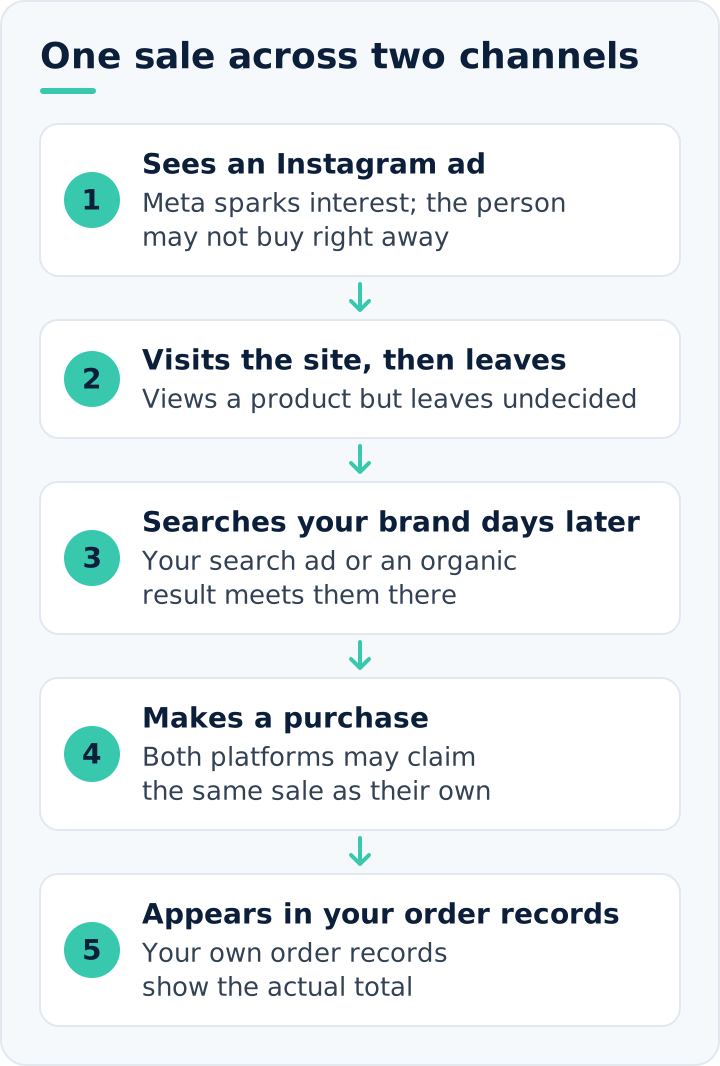
Compare using your own order records, not platform dashboards: how do total orders change when you adjust spending on a channel? This is the real measure behind the Google Ads versus Meta decision, not the return shown in the dashboard.
Common Misconceptions
- “Meta is only for awareness.” A well-built Meta campaign generates sales directly; it is the main sales channel for many e-commerce brands.
- “Google is expensive.” A click may be expensive, but it comes from someone close to buying. Cost per sale, rather than click price, shows whether it is truly expensive.
- “My competitor is there, so I should be too.” You do not know your competitor’s profit margin or goals. A channel that works for them may not work for you.
- “I tried once and it didn't work.” Most failed tests reflect setup issues rather than channel failure: wrong keywords, weak visuals, missing measurement or too little time.
When Does It Make Sense to Start Both Together?
If your budget can generate enough sales on both channels for the systems to learn, there is no reason to wait. A product that people search for and find visually appealing lets the channels reinforce each other: someone sees it on social media then searches, while a searcher later sees a social reminder. These reminders to previous website visitors are called remarketing.
Both channels can also launch before a busy period. Appearing on only one channel as demand rises during campaign week leaves some sales to competitors. Even then, prioritise the channel with the strongest results so far.
When launching both channels, give each a separate role and assess it accordingly. Search campaigns capture existing searches; social campaigns reach people unfamiliar with you. Expecting the same return from both may lead you to unfairly stop the campaign bringing new customers.
The Right Sequence When Starting on a Limited Budget
- Start with one channel. Splitting a small budget in two leaves both channels with too little data for their systems to learn.
- Set up measurement on day one. If purchases, form submissions and calls are not counted correctly, you cannot know which channel works.
- Allow four to six weeks. The first weeks are a learning period; deciding too early can be misleading.
- Launch the second channel with retargeting. If the first channel works, start the second by targeting previous visitors who did not buy. This is the lowest-risk starting point.
- Then use the second channel to find new customers. If remarketing is profitable, expand to campaigns reaching people who do not yet know you on the same channel.
Example: a clothing brand with 30,000 TL a month allocates almost all of it to Meta for the first two months, keeping only a small search campaign for people searching its name. Once sales become consistent in the third month, it shifts part of the budget to Shopping ads and tracks how both channels affect total orders.
Brief Examples by Industry
- Clothing and accessories store: Meta first. The product sells visually; shopping ads on search are the second step.
- Spare parts or technical products store: start with search and Shopping ads. Buyers search by part name or code.
- Local services (repairs, clinics, courses): start with search. Add Meta later for local awareness and reminders.
- Business software or services: search first. Decision-makers search by describing their problem; social media is used to build trust through content.
- A new product with no market equivalent: start with Meta. You must create demand until search volume develops.
- High-value products requiring longer consideration (furniture, real estate): use both. Social media sparks interest; search captures the decision.
This is a starting point, not a rule. Businesses in the same industry differ in margins, product range and content strength; the first weeks’ data provides the real answer.
Five Questions to Help You Decide
- Do customers search for your product by name or need, or do they want it after seeing it?
- Is search volume sufficient, and does cost per click fit your margin?
- Can you regularly produce new images and videos?
- Does the first screen show search visitors what they are looking for?
- Can you track sales by channel using your own records?
Start with search if your first two answers are “yes”; start with Meta if the first is “they want it when they see it” and the third is “yes”. If questions four and five are “no”, fix the website and measurement before choosing either channel. If you are unsure, our performance marketing team can examine your product’s search demand and margin together and create a channel plan for the first three months.
FAQs About Choosing Google Ads or Meta
Are Instagram and Facebook ads run separately?
No. Both are managed through Meta Ads Manager, and one campaign can run across both apps. You can choose placements in feeds, Stories or short videos, or let the system decide. Broad placements initially help the system find cheaper ways to reach the same audience; narrow them if your creative suits only one placement.
Is a Performance Max campaign a search ad?
Not exactly. Performance Max can appear across search, Shopping, YouTube, and display placements in one campaign, so some results come from existing searches and others from discovery. Because sales from people searching your brand by name can also be attributed to this campaign, evaluate it against total orders and new customer numbers.
How do you compare the two channels when Meta underreports sales?
First bring measurement on both sides to the same standard, then compare it with your own order records. Browser-based measurement misses some sales because of cookie consent and browser restrictions. Meta's Conversions API, which sends website data through your server, and Google's enhanced conversions help reduce this loss. Strengthening measurement on only one side will make that channel look better than the other.
Are TikTok ads more like Google Ads or Meta?
It is similar to Meta: TikTok ads are also mainly shown in the feed to people watching videos, and you create demand. The criteria we listed for Meta therefore apply to TikTok too, with one important difference: almost everything here is communicated through vertical video. If you cannot produce video regularly, starting on Meta with images and short videos is easier.
Do local businesses have to advertise to appear on Google Maps?
No. Google Business Profile is how you appear on Maps for free. Advertising gives the profile more prominent placement in search and map results and visibility across a wider area, but does not replace it. Before advertising, complete your opening hours, phone number, address and photos, and respond to customer reviews; a business with a weak profile will also look weak in map ads.